
Finding An Apollo Rocket Engine in the Deep Ocean
- Aug 23, 2013
- 6 min read
Updated: Jan 12
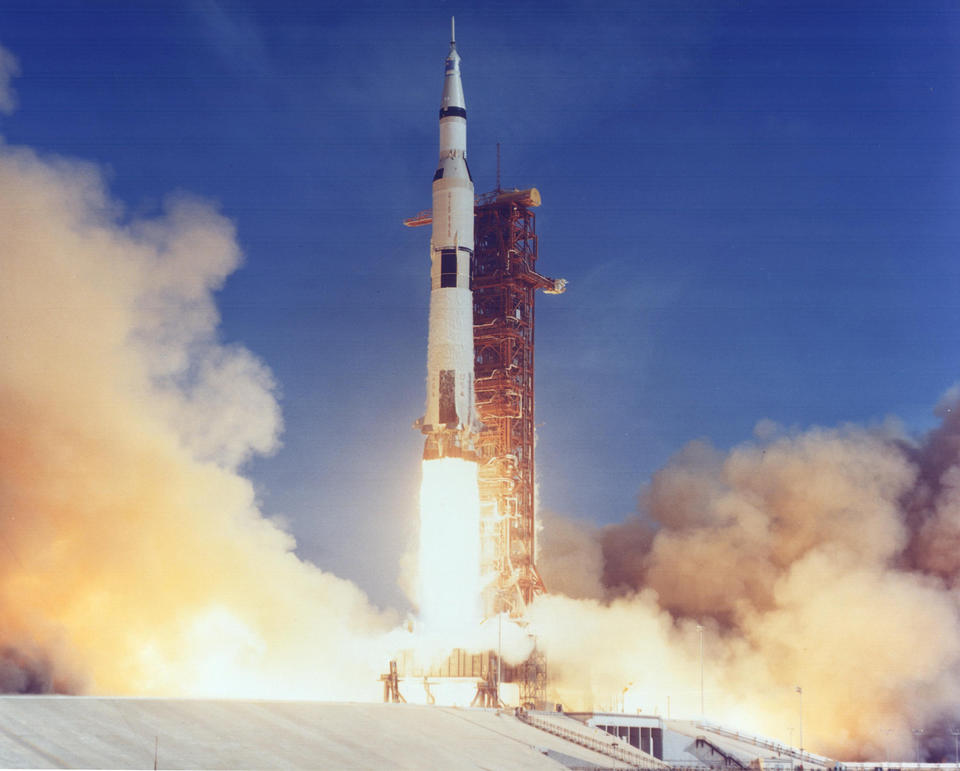
Undeniably, one of the last century’s greatest achievements was man setting foot on the moon. And while technology continues marching forward, there is one famous icon of those lunar landings that has not yet been bested. The F-1 rocket engine remains the most powerful single-chamber liquid-fueled rocket engine ever developed.
One of the engines that propelled Neil Armstrong to that historic first step is now being lovingly restored at the Kansas Cosmosphere & Space Center.

How did it get to the Cosmosphere from several miles beneath the Atlantic Ocean? The first stage of the 363-foot-tall Saturn V rocket contained five F-1 engines.
These were the main engines that lifted the rocket from the launch pad, starting the long journey to the moon. The first stage propelled the Saturn V for about 160 seconds, then separated from the rocket, falling back to Earth and splashing down in the Atlantic Ocean approximately 460 miles off the Florida coast.
Although NASA calculated where these mammoth first stages would fall, no one actually knew if the first stage landed intact or broke up in flight. If the first stage broke up prior to hitting the water, the search for the engines could end up covering large sections of territory. Based on the available data, the search team planned to cover more than 100 square miles. However, depending upon the targets located and time permitting, there was certainly more area than that to search.

Water depths in the search area were over 14,000 feet deep, where no light penetrates. Using cameras with powerful lights could only penetrate very limited distances, and with a large search area, take years to search thoroughly. Due to the limitations of light and visual techniques, most underwater search operations utilize sonar. When talking of sonars, many people recall their use in World War II to locate submarines. The sonar transmits an acoustic pulse also known as a ping, which reflects off mid-water targets, determining a range and bearing to the object. Locating relatively small items on the seafloor requires a different type of sonar.
The key is producing acoustic imagery of the sea floor with sufficient resolution to locate the target while also covering as much ground as possible. These bottom-imaging sonars are also known as side scan sonars. These systems can generate high-resolution images of the seafloor, depicting geology or targets such as shipwrecks. The same type of sonar is used by the navy to detect submerged mines, by oil and gas firms to map pipelines, and by scientists to map ocean-bottom habitat.
The data provide overhead images of the seafloor, allowing one to see details such as the mast of a sailing ship. Unlike true photographs, sonar images are generated by sound pulses. Photographs require light, which has an extremely limited range underwater. Side scan sonar can cover hundreds of meters of seafloor in a single pass. The sonar is deployed from a long cable on a torpedo-shaped sensor called a towfish or carried by an independent robot submarine called an autonomous underwater vehicle (AUV). Two transducers on either side of the towfish send and receive acoustic pings, producing two sets of bottom imagery, one for each scanned side. Thus, the side scan moniker.
One limitation of side-scan sonar is the trade-off between range and resolution. The F-1 rocket engines were scattered over hundreds of square miles. The search team needed to cover large swaths of sea floor with each pass of the sonar. Due to the physics of sound in water, the longer the range, the poorer the resolution of sonar. At short ranges, side scan will image small, hard-to-detect objects such as drowning victims. At long ranges, only larger or highly reflective targets such as metal debris are visible. Scanning over 1000 meters (all sonar ranges use scientific metric units: 1 meter = 3.28 feet) on each side, the capability to detect objects remains very good; however, the definition is less precise. We can see targets, but only experienced operators can analyze the imagery, and even then, it is part learned art and part science.
Science, however, has provided a new synthetic aperture sonar (SAS) which does not lose resolution at long ranges. The new sonar can see targets at over 1000 meters with a resolution of a few inches. That is the equivalent of seeing something as small as an aircraft propeller from a distance of 10 football fields or more. The team brought both conventional side-scan and SAS systems on the expedition, as the new SAS had not yet been fully tested.
Both the SAS and the conventional side scan sonar work by towing the sonar close to the sea floor from a long cable. The acoustic signals are transmitted up the cable to a computer onboard the ship, which displays real-time images of the sea floor. The sonar’s position is integrated into the data, and operators click on the imagery to determine target position, size and height above bottom. Equipment robust enough to survive the deep ocean and transmit data back to the ship over several miles of cable is large and expensive.

The new SAS system cost more than $1 million to develop. The towfish was over 15 feet long and weighed six tons. It also required 10,000 meters or 32,800 feet of wire to get the towfish close enough to the sea floor over two miles below the ship. That spool of cable alone weighed more than 20 tons. Additionally, there is a large hydraulic power until which powers the cable winch. The equipment is operated by a team of search specialists who travel with it and are separate from the ship’s crew. Once on station, the search team will work 24 hours per day, seven days a week, until the job is completed. All the search equipment and additional crew required a large ocean-going ship over 200 feet long, with a large A-frame at the stern. The A-frame supports a large wheel, called a sheave, over which the cable runs into the ocean. The sheave automatically measures the length of cable deployed to assist in calculating the towfish position.

The search team met the ship in Norfolk, Virginia, where all the search equipment was offloaded from several 18-wheeler trucks onto the vessel. The winch with cable and the hydraulic power unit had to be lifted by crane, placed onboard, and welded to the deck. The towfish, computers, and specialized navigation systems were also loaded aboard. All systems were assembled and tested prior to departure from the dock. When all the equipment was ready, the ship departed from Norfolk, heading southeast toward the search area.
Hurricane season officially begins in the Western Atlantic Ocean on June 1st and lasts through November 30th. Ocean commerce does not stop during the season, but vessels do monitor the weather. Hurricanes were moving up the central Atlantic but luckily did not approach the search area. The survey ship hugged the coast while transiting to avoid the large waves created by hurricanes hundreds of miles away.
As the seas settled, the ship reached the search area, and the team launched the SAS towfish. Deploying a deepwater sonar towfish to the bottom is a time-consuming process that takes more than five hours. This was the first deepwater deployment of the SAS system, and the images relayed via the fiber-optic cable were outstanding. The detailed images vividly displayed sand ridges and furrows, features previously not discernible in deepwater acoustic imagery. But the team’s elation was quickly replaced with frustration as the four large computer monitors went dark. Although the technology had proven effective, there was a problem with the fiber-optic lines in the cable.
The team recovered the towfish and quickly replaced the SAS with the older side scan sonar. This low-frequency, long-range system covered the same 1200 meters per side, however, with significantly less resolution. The first survey line was over 30 nautical miles long, and for seven days, round the clock, the team scanned the ocean bottom, covering more than 180 square miles of seafloor. Each target position was plotted and matched to flight trajectories from multiple Apollo missions. The debris seemed to correlate with NASA’s calculated positions, although the data points appeared further down-range than had been expected.
After mapping over 180 square miles of seafloor, the team had located 18 debris concentrations, with hundreds of pieces scattered between them. Back onshore, the team pored over the data for months, calculating which debris fields represented debris from different Apollo missions. The ultimate goal was to recover the F-1 engines from Apollo 11, the first mission to land humans on the Moon. Since deploying deepwater robots to debris fields is time-consuming, the goal was to place the robots on debris most likely from the Apollo 11 mission. Once at the bottom, the robots could not travel miles to the next location without first being recovered to the ship; each time, this would take four to six hours. The completed analysis indicated three debris fields in close proximity, consistent with the Apollo 11 flight azimuth. With that data in hand, the green light was given for Phase II: recovery of the F-1 engines.
Phase II commenced with the selection of a ship equipped with deep-ocean robots capable of handling the recovery. Join us for our next post examining the ship and robots needed to lift a nine-ton object from over two miles beneath the ocean.
© Copyright Vince Capone 2013
Printed with permission from Bezos Expeditions.


Comments